CAR-T Cell Therapy: The Market Is Resetting, Not Retreating
Despite recent portfolio rationalizations and changing investment priorities, the CAR-T market continues to evolve. The next phase of growth will be driven by manufacturing innovation, next-generation platforms, broader patient access, and commercial scalability rather than scientific proof-of-concept alone.
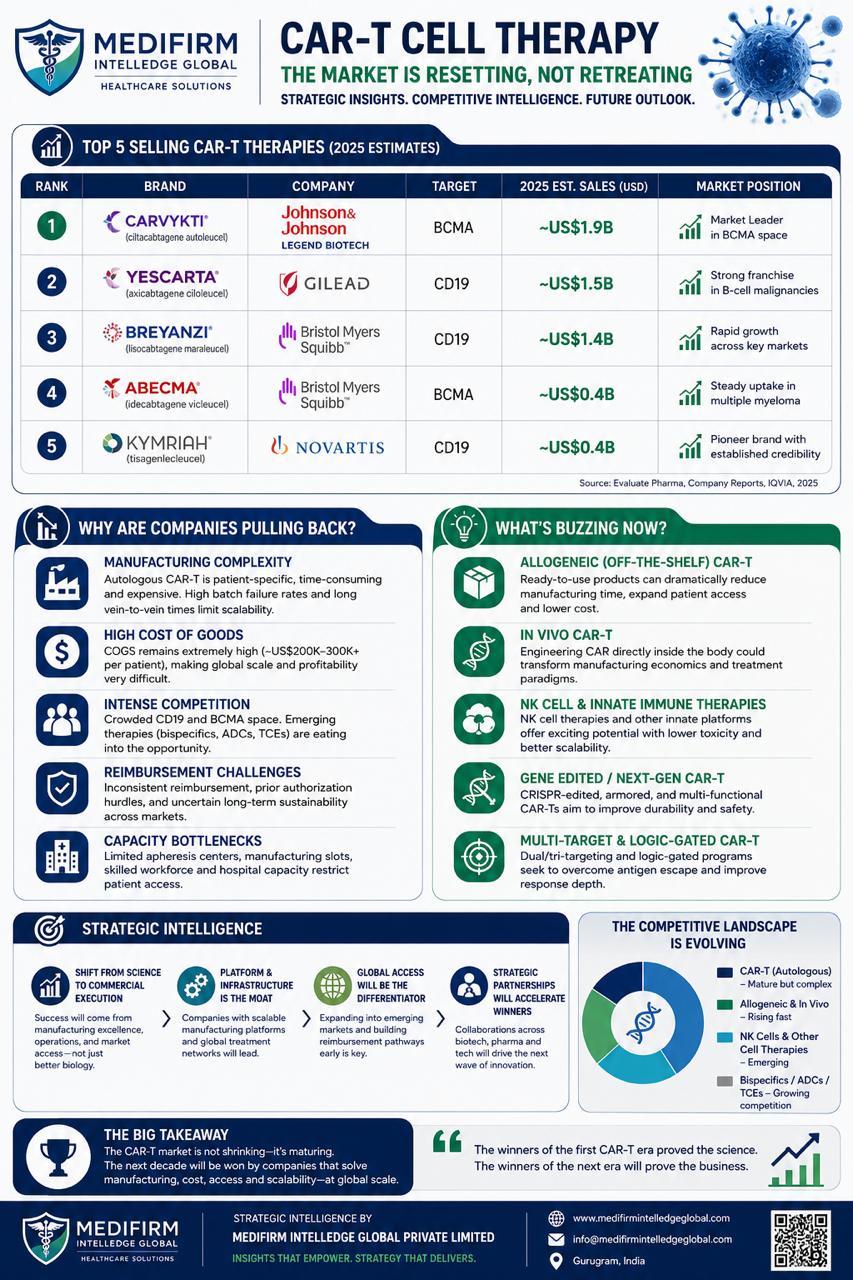
CAR-T Cell Therapy: The Market Is Resetting, Not Retreating
The Cell & Gene Therapy landscape is entering a new phase of maturity. While several companies have reduced investments or exited selected CAR-T programs, this should not be interpreted as a decline of the technology itself.
Instead, the industry is shifting its focus from scientific validation to sustainable commercialization.
The next generation of CAR-T innovation will be defined by scalable manufacturing, improved accessibility, lower treatment costs, and next-generation engineering approaches.
---
Market Snapshot
According to 2025 industry estimates, the leading commercial CAR-T therapies include:
| Brand | Company | Target |
|--------|----------|---------|
| Carvykti® | Johnson & Johnson / Legend Biotech | BCMA |
| Yescarta® | Gilead Sciences | CD19 |
| Breyanzi® | Bristol Myers Squibb | CD19 |
| Abecma® | Bristol Myers Squibb | BCMA |
| Kymriah® | Novartis | CD19 |
These therapies continue to establish CAR-T as a transformative treatment option in hematologic malignancies.
---
Why Are Some Companies Pulling Back?
Recent strategic portfolio decisions reflect commercial realities rather than limitations of CAR-T science.
Manufacturing Complexity
Autologous CAR-T therapies require individualized manufacturing, lengthy production timelines, and highly specialized infrastructure, creating operational challenges and limiting scalability.
High Cost of Goods (COGS)
Manufacturing costs remain among the highest in the pharmaceutical industry, placing significant pressure on reimbursement, pricing, and long-term commercial sustainability.
Increasing Competition
The competitive landscape has expanded rapidly with:
Companies must now differentiate beyond clinical efficacy alone.
Reimbursement Challenges
Market adoption continues to depend on reimbursement policies, healthcare infrastructure, and payer willingness to support high-cost personalized therapies.
Capacity Constraints
Limited manufacturing facilities, skilled workforce availability, and treatment center capacity continue to restrict patient access.
---
What's Buzzing Now?
The next wave of innovation is already taking shape.
Allogeneic (Off-the-Shelf) CAR-T
Ready-to-use therapies aim to reduce manufacturing time, improve accessibility, and significantly lower production costs.
In Vivo CAR-T
Researchers are exploring approaches that engineer immune cells directly inside the patient's body, potentially eliminating traditional manufacturing processes.
NK Cell & Innate Immune Therapies
Natural Killer (NK) cell therapies offer opportunities for improved scalability and potentially lower toxicity.
Gene-Edited & Next-Generation CAR-T
CRISPR-enabled engineering, armored CAR-T, and multi-functional constructs are designed to improve persistence, safety, and therapeutic durability.
Multi-Target & Logic-Gated CAR-T
Next-generation designs seek to overcome antigen escape while improving treatment precision and long-term outcomes.
---
Strategic Intelligence
The competitive landscape is evolving beyond scientific discovery.
Future market leadership will depend on:
Companies that build scalable platforms rather than individual products will likely achieve long-term competitive advantage.
---
Executive Perspective
The CAR-T market is not shrinking—it is maturing.
The first generation of leaders demonstrated that CAR-T science works.
The next generation of leaders will demonstrate how advanced therapies can be manufactured efficiently, commercialized globally, and delivered sustainably to larger patient populations.
---
Key Takeaway
Future success in Cell & Gene Therapy will increasingly depend on operational excellence rather than scientific innovation alone.
Organizations that successfully integrate manufacturing, commercialization, regulatory strategy, and patient access into scalable business models will define the next decade of advanced therapeutics.
---
Sources & Credits
Prepared by Medifirm Intelledge Global Private Limited